← All questionsETHICAL QUESTION / 14

A DILEMMA TO THINK WITH

An unjust law.

When is breaking a law a responsible way to challenge injustice?

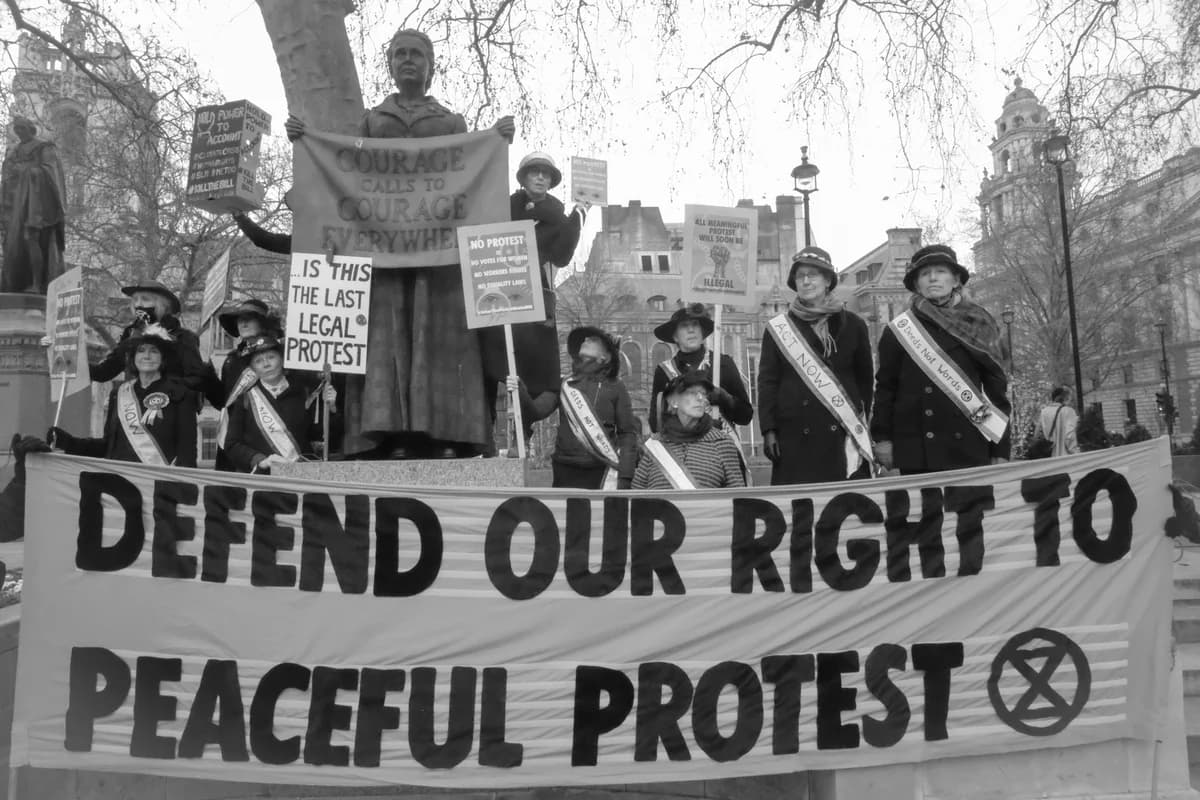
People carrying placards at a protest in London in January 2022
01 / THE SCENARIO

Imagine this.

A law excludes a group from an essential public service. After lawful campaigns fail, protesters deliberately and peacefully violate that law to demand reform. Their action also disrupts people who did not create the injustice.

THE CENTRAL QUESTIONWhen is breaking a law a responsible way to challenge injustice?
GO DEEPER / CONTEXT & DEBATE

What makes this difficult?

Understanding the topic

An unjust law creates a conflict between obeying public institutions and refusing participation in wrongdoing. Civil disobedience is often distinguished by conscientious political purpose and communication with a broader public. Its justification depends on the injustice challenged, available alternatives, and the burdens imposed by the method.

Obedience can support predictable cooperation, yet a law’s existence does not establish its justice. A protester may argue that ordinary channels are inaccessible or repeatedly fail to address a serious wrong. The method must then be assessed alongside the grievance. A public breach can communicate refusal and invite collective judgment, but it can also burden bystanders. The central problem is how resistance can challenge institutions while still taking the claims of other people seriously.

An illustrative example

Imagine a peaceful sit-in blocking access to an administrative office. Contrast it with a secret refusal to follow the same rule. Identify whether publicity affects the act’s message, its effectiveness, or its moral justification; then consider the impact on people seeking essential services.

Where the debate stands

Nonviolence, openness, and willingness to accept punishment are debated features rather than universally agreed requirements. Legal permission and moral justification also differ. A defensible account explains why disruption is proportionate, how affected people are heard, and whether ordinary democratic channels are genuinely available to those protesting.

In the sit-in example, ask whether the disruption targets the responsible institution or mainly falls on people with little influence over the disputed policy. Consider warnings, access for essential needs, and less burdensome tactics that could serve the same purpose. These questions do not assume that harmless dissent will always succeed. They make proportionality concrete and help distinguish an argument for justified disruption from the broader claim that any conscientious tactic is acceptable.

Background referencesCivil Disobedience
02 / WAYS OF THINKING

Look through more
than one lens.

These are starting points for reasoning, not verdicts. Different thinkers within the same tradition can disagree.

People carrying placards at a protest in London in January 2022

Civil disobedience

Examine the purpose, publicity, and methods of principled protest.

ASK YOURSELF

Must protesters accept punishment for their action to be justified?

Understand this lens

Understanding the topic

Civil disobedience is a conscientious breach of law aimed at challenging a law, policy, or institutional injustice. Many accounts emphasize communication, public action, and nonviolence, while others revise those conditions. It differs from ordinary lawbreaking primarily through its purpose and relation to political justification.

Political lawbreaking can aim to communicate injustice, interrupt a harmful practice, or create pressure for change. These purposes are related but distinct. Publicity may support a communicative aim, while secrecy could sometimes protect people facing retaliation. Accounts of civil disobedience disagree about which features define the category and which justify an instance. Keeping definition and justification separate prevents a dispute over terminology from deciding whether a particular act of resistance has adequate moral reasons.

Explore the example and debate

An illustrative example

Imagine refusing a discriminatory administrative requirement and explaining the refusal publicly. Contrast an identical breach undertaken for personal convenience. The outward act is similar, but its reasons and message differ. Still, good reasons do not automatically justify every tactic.

Where the debate stands

A central issue is how obedience supports fair cooperation while dissent can expose failures within it. Last-resort requirements, proportionality, and willingness to accept punishment are disputed. The assessment should consider barriers to lawful change and the burdens on bystanders, rather than treating legality or disruption alone as decisive.

Consider a fictional protest against an exclusionary public rule. Ask who bears the disruption, whether the institution can hear the grievance through ordinary channels, and how the method connects to the wrong opposed. Willingness to accept punishment may convey sincerity, but it is a further claim that suffering punishment is always required. A reasoned judgment evaluates the protest’s circumstances and competing duties, instead of making legality, visibility, or disruption a complete test by itself.


Background referencesCivil Disobedience
Read the full topic ↗
The Lady Justice statue above the Old Bailey

Justice as fairness

Assess the law against fair terms of social cooperation.

ASK YOURSELF

How should people challenge a rule they could not reasonably accept?

Understand this lens

Understanding the topic

Rawls’s justice as fairness concerns the basic structure of society: institutions that distribute rights, opportunities, benefits, and burdens. Its principles protect equal basic liberties, require fair equality of opportunity, and restrict permitted social and economic inequalities through the difference principle. The original position offers a way to justify those principles.

Justice as fairness focuses on the basic institutions shaping people’s opportunities and life prospects. An institution can be efficient yet unfair if its advantages depend on social positions that people cannot reasonably control. The original-position device asks which principles people could select without exploiting knowledge of their own position. This approach shifts attention from a single generous transaction to enduring arrangements that influence who can obtain education, exercise liberties, and participate as an equal.

Explore the example and debate

An illustrative example

Imagine two education systems with the same formal right to apply. One leaves access strongly dependent on family resources; the other provides support to make opportunities meaningfully comparable. This tests the difference between equal permission and fair opportunity.

Where the debate stands

The difference principle is not simply a command to maximize everyone’s total welfare. It assesses inequalities by their benefit to the least advantaged, subject to prior requirements. Critics question the treatment of dependency, the social goods used for comparison, and how far the framework extends beyond a society’s own institutions.

In an imagined town, equal application rules may coexist with unequal access to the information needed to apply. Assess the institution across its whole process, including preparation, participation, and correction. A fair rule needs more than a neutral phrase if its design predictably excludes certain residents. At the same time, changing the rule requires public reasons: responding to disadvantage should be explainable through the institution’s purpose and the claims of those affected.

Background referencesOriginal Position
Read the full topic ↗
Waves rolling onto a sandy coastline

Consequentialism

Compare the prospects for reform with the disruption and risks of escalation.

ASK YOURSELF

What costs may fairly be imposed on bystanders?

Understand this lens

Understanding the topic

Consequentialism makes moral assessment depend on consequences, but it is a family of views rather than a synonym for counting pleasure. The relevant good might include welfare, knowledge, fairness, or other values. The thing assessed might be an act, a rule, an institution, or a disposition.

Several choices define a consequentialist view: what counts as good, which consequences are relevant, and what object is evaluated. Assessing an act’s actual outcome differs from assessing its expected effects using the information available beforehand. Assessing a rule’s general acceptance differs again. These distinctions can produce disagreement within the family of theories. An argument should therefore identify its version clearly, rather than treating every appeal to benefit as the same calculation or assuming that only pleasure can count.

Explore the example and debate

An illustrative example

Imagine two emergency plans with different expected benefits and risks. Compare assessing what actually happens with assessing what could reasonably have been predicted beforehand. A bad outcome does not necessarily show that the original choice was irresponsible.

Where the debate stands

Critics raise concerns about rights, demandingness, and uncertainty. Defenders differ about maximizing versus satisfactory outcomes and about how to recognize valuable consequences. A useful application states the good being promoted, the alternatives compared, and the information available; otherwise an apparent calculation can hide its most controversial assumptions.

Imagine a public project that fails despite careful planning and another that succeeds through an irresponsible gamble. Judging only the realized outcome ranks them differently from judging the decisions by reasonable expectations. This does not eliminate concern for what happened: people harmed by failure still need assistance. It distinguishes evaluating a choice from responding to its consequences. The distinction helps prevent luck from becoming the sole measure of whether an institution exercised responsible judgment.

Background referencesConsequentialism
Read the full topic ↗
03 / INTO THE WORLD

Where this question
shows up today.

Thought experiments simplify reality. These links show where a similar tension appears in a richer social context.

04 / READ FURTHER

Follow the sources.

Philosophical connections in this atlas are curated interpretations. Read the original discussions and reference entries to go deeper.

KEEP EXPLORING

The next question
changes everything.

The trolley problemThe transplant case

